

 48616 Reads
 18 mins


Imagine you have just made up your mind to go solar, and suddenly every installer is throwing words like mono, poly, PERC, and TOPCon. But nobody is explaining what any of it actually means for your home and your wallet. Choosing between monocrystalline vs polycrystalline panels needs to be a practical decision that affects how much electricity your system generates.
Unlike polycrystalline solar panels, which are made of multiple silicon crystals and deliver lower efficiencies of 16-17%, the latest monocrystalline solar panels made of half-cut PERC cells can reach high efficiencies of up to 22.5%. Monocrystalline panels also tend to degrade more slowly, often at ~0.5% per year, while some polycrystalline modules may degrade at ~0.8% per year under harsher conditions. Over 25 years, the difference in output and savings becomes huge.
Due to their lower efficiency, faster degradation rate, and higher temperature coefficient than that of mono panels, polycrystalline solar panels are now almost obsolete in India. They are rarely used to build new rooftop solar panel systems for homes, housing societies, and commercial buildings. Nowadays, TOPCon bifacial solar panels made of mono-PERC half-cut cells offer a better ROI, faster payback, and better performance over the years.
In this blog on monocrystalline vs polycrystalline solar panels, we will explain the major difference between monocrystalline and polycrystalline panels, offer a detailed ROI breakdown against the cost of installing an on-grid rooftop solar system in India in 2025, and talk about the reasons why monocrystalline solar panels with PERC half-cut silicon cells are the best choice for Indian rooftops.
What are Monocrystalline solar panels?
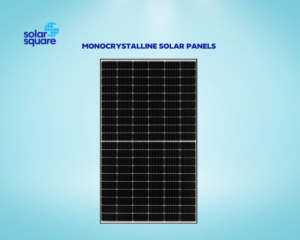
Monocrystalline solar panels, or mono solar panels, are nothing but a semiconductor device made with a single, continuous silicon crystal. These panels are black in colour and offer an efficiency range of 19% to 20%. The efficiency reaches up to 22.5% in advanced mono panels with PERC half-cut cells. These panels also perform well in low-light, high-temperature, and partially shaded conditions.
A single-crystal silicon ingot is formed using the Czochralski process (an industrial method to make a large, highly pure crystal through melting). These silicon ingots are sliced into thin wafers and doped with chemicals to improve electrical conductivity. On the rear side, a passivation layer is added to reflect unabsorbed light.
Once the cells are formed, each full cell is cut into two halves to reduce energy loss and improve shade tolerance. The half-cut monocrystalline PERC cells are connected and laminated to create the final panel.
Monocrystalline solar panels are ideal for homes with limited or partially shaded rooftop space, cities with extreme summers or heavy monsoons, and homeowners thinking about a 25-year return on investment.
What are Polycrystalline solar panels?
Unlike monocrystalline solar panels that use a single silicon ingot, polycrystalline solar panels are made by fusing multiple silicon crystals. These panels are usually blue, have a lower efficiency of 16-17%, and feature a higher degradation rate compared to monocrystalline panels.
In the process of making poly solar panels, recycled or raw silicon fragments are melted down in a crucible. The melted silicon is poured into a square mold and cooled to form a large block. After this, the silicon block is cut into thin square wafers and is treated and doped to form a photovoltaic cell. These poly cells are wired, laminated, and framed to form the solar panel.
People who have large, open, unshaded rooftops where space is not a constraint, budget-conscious installations, farms, warehouses, and rural setups can choose polycrystalline panels.
Monocrystalline vs Polycrystalline Solar Panels?
The main difference between monocrystalline and polycrystalline solar panels is that the former is made of a single silicon ingot, which results in a higher efficiency of 19-20%. When a PERC layer is added and the cells are cut in half, the efficiency shoots up to 22.5%. Poly panels, on the other hand, are made of multiple fragments of silicon and have a lower efficiency of 16-17%.
Before we take you deeper into the difference between mono and poly solar panels, here’s a simple table that demonstrates how these panels truly differ across various features:
| Features | Mono Panels with Half-Cut PERC cells | Polycrystalline Solar Panels |
| Silicon type | Single crystal of silicon | Multiple melted silicon fragments |
| Appearance | Uniform black color | Speckled blue color |
| Efficiency | Up to 22.5% | 16-17% |
| Degradation rate | ~0.5% per year | ~0.8% per year |
| Temperature coefficient | ~-0.32% per °C | ~-45% per °C or higher |
| Heat performance | Better due to a lower temperature coefficient. | Not that great because of a higher temperature coefficient. |
| Shade tolerance | Higher due to the half-cut cell design | Poor |
| Space efficiency | It’s higher because less space is needed to achieve the same output. | It’s lower as more space is needed to achieve the same output. |
| Availability in Indian market | Readily available as it’s the most popular choice for rooftop solar installations. | Sharply declining as the technology is almost obsolete. |
Now, let’s compare the differences between monocrystalline and polycrystalline solar panels in greater detail.
Efficiency of Monocrystalline and Polycrystalline Solar Panels
The efficiency of a solar panel determines how much sunlight it can convert into usable electricity. Monocrystalline panels deliver higher efficiency (19-22.5%) because of their single-crystal structure, while poly panels have lower efficiency (16-17%) due to the use of fragmented silicon.
Let’s check out all the main factors regarding the difference between the efficiency of mono vs poly solar panels.
- Silicon structure: Mono panels are made from a single silicon crystal, which lets electrons move smoothly. Poly panels have multiple grain boundaries that interrupt the electron flow, lowering efficiency.
- PERC layer advantage: Adding a Passivated Emitter and Rear Cell (PERC) layer in mono panels reflects unused light into the cell. It boosts their efficiency to ~22.5%. Poly panels lack this upgrade.
- Half-cut cell design: In modern mono-PERC panels, each cell is split in half, which reduces resistive losses and increases power output. This isn’t the same with poly cells.
Shade Performance of Mono Panels vs Poly Panels
Shade can significantly reduce the energy output of a solar system. Half-cut cell technology in mono panels allows them to handle shade much better than poly panels.
Let’s check out all the main factors regarding the difference between the shade performance of mono vs poly solar panels.
- Half-cut cell design: Each mono cell is cut into two halves. So, even if one part of the panel is shaded, the other half continues to produce electricity. Poly panels lack this benefit.
- Bypass diodes: Mono panels have advanced bypass diodes that minimize power loss under shaded conditions. On the other hand, poly panels are more likely to suffer from hotspot formation.
- Energy yield in partial shade: In real rooftop conditions, monocrystalline PERC half-cut panels consistently deliver more energy per square meter when trees, buildings, or water tanks shade parts of the roof.
Heat Tolerance and Temperature Coefficient of Monocrystalline vs Polycrystalline Solar Panels
Heat tolerance simply indicates how well a panel keeps its power when it gets hot. The temperature coefficient tells you how much power a panel loses for every 1°C rise above 25°C. Needless to say, the lower the temperature coefficient, the better the heat tolerance.
Since monocrystalline solar panels have a lower temperature coefficient of -0.32% per °C* , monocrystalline solar panels perform better under extreme heat.
Let’s check out all the main factors regarding the difference between the heat tolerance of monocrystalline vs polycrystalline solar panels.
- Hot climate advantage: With lower power loss in heat, mono panels produce more electricity in Indian summers, while poly panels show a sharper drop.
- Higher system ROI: Better heat tolerance directly translates into higher energy generation over 25 years, improving the payback of monocrystalline solar panels compared to polycrystalline solar panels.
- Half-cut design helps indirectly: Half-cut cells reduce current per path, which lowers resistive heating inside the panel. Less internal heating supports better performance as temperatures climb.
*Please note: A value of -0.32% per °C means panel power falls by ~0.32% for every 1°C rise in cell temperature above 25°C, assuming other conditions remain unchanged.
Degradation Rate and Lifespan of Mono vs Poly Panels
While both polycrystalline and monocrystalline solar panels from reputable solar panel manufacturers last for 25+ years, the main difference erupts because monocrystalline panels degrade at a much lower rate. It means that at the end of their 25-year life, monocrystalline solar panels will perform at a high efficiency and give more energy output than polycrystalline solar panels.
Let’s check out all the main factors regarding the difference between the degradation rate of monocrystalline vs polycrystalline solar panels.
- Lower annual degradation: Good-quality mono panels from manufacturers like ReNew Solar, Rayzon, and Premier Energies usually lose efficiency by ~0.5% per year, or even less. On the other hand, many poly panels lose ~0.8-1% efficiency per year. Over 25 years, that gap compounds into noticeably higher energy from monocrystalline solar panels.
- Better passivation and PID resistance: Mono-PERC cells use rear-side passivation that reduces recombination losses. Many tier-1 mono modules also use anti-PID (Potential Induced Degradation) materials, which help preserve output in humid and high-voltage conditions.
- Financial impact: Slower degradation means monocrystalline panels generate more units of solar electricity over decades, ensuring higher lifetime returns.
Space Efficiency of Mono vs Poly Solar Panels
Space efficiency relates to how many watts of power you can fit per square meter of roof. Because monocrystalline cells are more efficient, they deliver more output from the same panel size. That means fewer panels and less roof area will be required to reach a given system size when compared to polycrystalline solar panels.
Let’s check out all the main factors regarding the difference between the space efficiency of monocrystalline vs polycrystalline solar panels.
- More watts per square meter: Higher cell efficiency in mono panels converts more sunlight within the same footprint. Thus, each square meter of roof yields more output than poly panels.
- Fewer panels for the same kW: You need fewer mono modules to hit a target capacity. Fewer modules also reduce losses from gaps, frames, and cable paths.
- Easier layout on rooftops with limited space: With fewer modules, it’s simpler to work around tanks, vents, and parapets. You can reach your target with fewer rows and less spacing.
- Less hardware and wiring: Fewer modules mean fewer rails, clamps, junctions, and string runs. It leaves more usable roof area and better roof access for solar module cleaning and servicing post-installation.
- Room for future expansion: Using less area today leaves space to add capacity later if your consumption grows.
Cost of Installing On-Grid Rooftop Solar Systems at Homes in India vs the ROI
Installing an on-grid rooftop solar system with bifacial mono-PERC solar panels reduces reliance on grid electricity, which gets more expensive by 3-6% every year. As a result, the electricity bills of homeowners get reduced by 90% or more.
Simply stating that on-grid rooftop solar offers a 90% monthly reduction in bills does not show the true impact of the savings you can make by not paying electricity bills. So, we’ve created a simple table that compares the cost of installing a 4 kW on-grid rooftop solar system in India vs the money the system will save for you by generating free solar electricity for 25 years:
| City | 4 kW Solar System Size in India With Subsidy (Starting Price – Indicative for Base Variant)* | Solar Savings in 25 Years* |
| Pune | ~₹ 1.82 lakh | ~₹ 23.77 lakh |
| Bhopal | ~₹ 1.82 lakh | ~₹ 14.85 lakh |
| Lucknow | ~₹ 1.62 lakh | ~₹ 9.85 lakh |
| Jaipur | ~₹ 1.7 lakh | ~₹ 13.97 lakh |
| Ahmedabad | ~₹ 1.79 lakh | ~₹ 17.45 lakh |
| Bengaluru/ Bangalore | ~₹ 2.15 lakh | ~₹ 12.97 lakh |
| Hyderabad | ~₹ 1.85 lakh | ~₹ 12.77 lakh |
| Delhi | ~₹ 1.65 lakh | ~₹ 9.5 lakh |
| Chennai | ~₹ 1.85 lakh | ~₹ 11.95 lakh |
*Please note prices are subject to change. The above-mentioned 4 kW solar panel price in India with subsidy is indicative as of 09 September 2026 for the SolarSquare Blue 6ft variant. The actual 4 kW solar plate price depends on your DISCOM charges, city, product variant opted for, panel type, inverter type, mounting structure height, type of after-sales service, savings guarantee, roof height, etc. Additionally, when calculating savings, we have considered an annual tariff escalation of 3% and an annual degradation of 1%. The actual final savings from for a 4 kW solar panel system depends on the types of solar panels you’ve installed and their efficiency, intensity of sunlight your rooftop receives, orientation of the panels and tilt angle, the pollution level and weather conditions in your city, the temperature, shadow on the roof, impact of dirt/dust, and how well you maintain your panels after installation.
Couldn’t find your city and the ideal rooftop solar system size based on your home’s power consumption in the table above? Use SolarSquare’s free solar power calculator to find out the estimated cost of installing a solar system that can fulfill all your home’s energy requirements vs the savings the same system will offer in 25 years in your city.
Conclusion
Monocrystalline solar panels with mono-PERC half-cut solar cells are better for residential and commercial installations in India because, unlike poly panels that have a lower efficiency of 16-17%, mono-PERC solar panels reach higher efficiencies of up to 22.5%. This directly translates into higher savings and a quicker payback period for you.
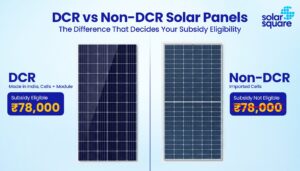
Upfront installation cost was traditionally the only drawback for mono panels, but it’s no longer a problem because the government offers a maximum subsidy of Rs. 78,000 to homeowners and a maximum subsidy of Rs. 90 lakh to housing societies that install on-grid rooftop solar panel systems. Plus, solar loans from banks and reduced module prices have made it extremely affordable for anyone to install rooftop solar systems.
For any further queries related to solar system installation at home, book a free solar consultation call with SolarSquare today!
Calculate your savings

Forecast your savings with solar on your investment on the SolarSquare’s plant
Frequently Asked Questions
How long do monocrystalline panels last?
A well-maintained mono panel from top-tier brands can last for 25+ years.
Which company’s solar panel is best for homes?
The most reputable solar panel manufacturers in India that you can trust include Rayzon, ReNew Solar, and Premier Energies.
Which lasts longer, monocrystalline or polycrystalline?
Both poly and mono panels from reputable brands last for 25+ years. What differs is the fact that the degradation rate of mono panels is lower than that of poly panels. Hence, they produce more output even after 25 years when compared to polycrystalline solar panels.
Do monocrystalline panels work in shade?
The latest technology monocrystalline solar panels that use PERC half-cut solar cells work well even in shade.
What are the disadvantages of polycrystalline solar panels?
They have a lower efficiency of 16-17% and their performance under shade is poor, too. Moreover, poly panels degrade faster, have a higher temperature coefficient, and their output reduces as the temperature climbs.
Which solar panel is best, mono or poly?
It depends on your roof and budget. If your rooftop is small or your city sees extreme summers, monocrystalline is the better choice. It gives more output, less space, longer life. If you have a large open terrace and want to keep costs down, polycrystalline does the job reliably. For most Indian homes, monocrystalline is the smarter long-term investment.
Which is better: monocrystalline or polycrystalline solar panels?
Monocrystalline solar panels are better than polycrystalline on factors including efficiency, heat performance, lifespan, and long-term ROI. On the other hand, polycrystalline wins on the initial cost. The price gap between the two has narrowed significantly in recent years, which makes mono the more sensible choice for most homeowners today. Monocrystalline panels give you better returns over a 25-year system life, unless you have abundant roof space and a very tight budget.
How are the newer technologies: TOPCon and Bifacial Panels?
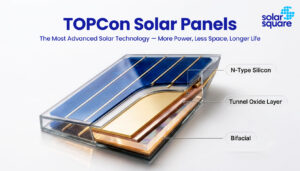
TOPCon panels are the next evolution of monocrystalline technology. They have an efficiency of 22–24%, lower degradation, and better performance in both heat and low light. On the other hand, bifacial panels generate electricity from both sides, boosting output by 10–30% on reflective rooftops. Both are monocrystalline-based.


 Previous Article
 11 min


![10 kW Solar Panel Price in India [With and Without a Subsidy]](https://cdn.solarsquare.in/blog/wp-content/uploads/2025/07/18165650/10-KW-solar-panel-300x167.webp)